

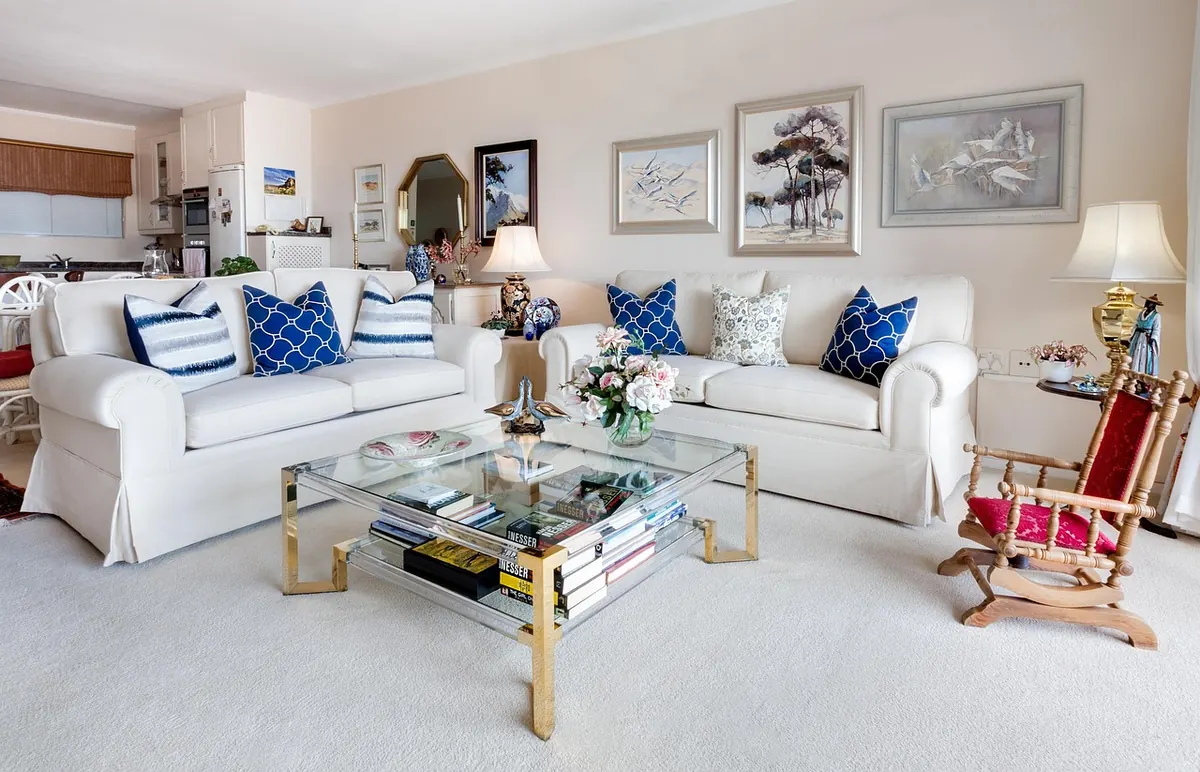
How to Style a Coffee Table in 15 Minutes: The 3-Layer Method
A coffee table has one job and about six competing demands: hold a drink, survive a foot, look like someone lives here. Most styling advice turns that into an afternoon and a shopping list. This doesn't. The three-layer method — height, texture, function — takes about fifteen minutes and uses what you already own. Stack the layers in order and the table reads as intentional, even when it's covered in remote controls and a half-finished crossword.
Layer 1: Height Builds the Shape
A table goes wrong when everything on it sits at the same level. Three objects roughly four inches tall, spaced evenly, look like inventory. Build a small skyline instead — three distinct heights:
- Low, 2 to 4 inches: a shallow ceramic bowl, a flat stack of two books, a dish for keys.
- Mid, 5 to 8 inches: a stack of three or four books with something on top, a short vase, a lidded wooden box, a chunky pillar candle.
- Tall, 10 to 16 inches: a single stem in a narrow vase, a small table lamp, a tall candlestick, a branch, a piece of sculpture you already own.
One tall, one mid, one low — that's the whole shape. Where most people go wrong is treating all three as equally important. Pick one to lead. The tall object usually wins, because it's what you see first from the doorway; everything else supports it. If the tall thing is a lamp, the mid and low layers should stay quiet and matte so they don't compete with the shade.
Arrange them in a loose triangle rather than a row. Don't line the objects up along the table's edge, and resist the urge to space them evenly — even spacing is what makes a surface look like a display shelf. Group two objects tightly and let the third sit apart, with a hand's width of empty wood between them. Empty tabletop is not wasted space; it's the pause that makes the rest look deliberate.
Tall object toward the back left, mid object front right, low bowl just off-center to the right. The eye travels in a curve instead of a straight line, and the table reads as composed from wherever you actually sit.
Watch the Scale
Height only helps if the proportions are right. As a rough rule, the tallest object should be no more than half the width of the table, and the whole arrangement should occupy no more than two-thirds of the surface. On a long rectangular table, that means leaving a genuine gap in the middle or splitting the table into two stations. On a small round table, it means three objects becomes two. Scale mistakes read as clutter; proportion mistakes read as clutter too, so you may as well fix both at once.
Layer 2: Texture Keeps It From Looking Flat
Height is the skeleton; texture is the skin. If everything on your table is smooth, glossy, and new, the arrangement will look like a showroom vignette — correct, and completely without life. What you want is contrast you can see from across the room. Three kinds do most of the work:
- Hard and soft: a stoneware bowl next to a folded linen napkin, or a smooth tray under a soft wool coaster.
- Matte and shiny: a matte paperback under a glass candlestick, or a rough ceramic mug beside a polished brass dish.
- Rough and smooth: a raw wood tray holding a glazed vase; a woven basket next to a stack of smooth magazines.
- Living and not: a single stem, a small plant, a bowl of lemons. Anything alive or recently alive makes a table look used rather than merchandised.
You don't need all four. Two is enough, and cheap materials do the job perfectly well — burlap, kraft paper, terracotta, a woven basket, a stack of magazines with a matte cover. This is not about expensive texture. It's about contrast your eye can register without effort.
The Fastest Texture Fix
If the table looks flat and you can't work out why, add one soft thing and one living thing. A linen napkin under the bowl, a single stem in the vase. Nine times out of ten, that's the whole fix — not another shopping trip, not a new table.
Layer 3: Function Keeps It Honest
The first two layers make the table look good. The third makes it usable, and usable is what keeps it looking good past Tuesday. A table with nowhere to put a drink gets cleared into a pile on the floor. A table with a designated landing spot absorbs clutter instead of accumulating it. Give each layer a job:
- A landing spot: a tray, a low bowl, a small basket — one place where keys, mail, and sunglasses go. The container matters less than the fact that there's only one of them.
- A coaster or trivet: the thing that saves the finish, and that looks intentional even when it isn't being used.
- Something current: the book you're actually reading, this month's magazine, the crossword. This is the detail that reads as personality, and it's the one thing worth rotating.
- A light source, if the table sits near a sofa: a small lamp, a candle, a matchbox. Function doesn't have to mean utility.
The Tray Rule
If you take one idea from this method, take the tray. A tray is a boundary. It announces that this much mess is allowed, and it lets you lift the entire contents off in ten seconds when you need the surface back for a pizza. Two trays is a collection; one tray is a system. On a round table, use a round tray — square corners will fight the curve every time.
The 15-Minute Sequence
Here's the order that keeps this from turning into an afternoon. Set a timer.
- Minutes 0–3: Empty it. Take everything off the table, including the things you've stopped noticing. Dust the surface. Put the objects in one pile on the sofa.
- Minutes 3–6: Choose three. One tall, one mid, one low. Hold them against the table. If you can't find a tall object you like, borrow a stem from a houseplant or a candlestick from the dining table — this is not a permanent commitment.
- Minutes 6–9: Place them. Loose triangle, off-center, one clear leader. Step back at least six feet; the table needs to look right from where you actually sit, not from directly above.
- Minutes 9–12: Add texture and function. One hard, one soft. One tray or bowl for landing. One current object.
- Minutes 12–15: Edit. Remove one thing. Then ask whether what's left would survive a week of real life. If an object has no job and no contrast, it's clutter wearing a nicer outfit.
Three Mistakes That Undo the Work
Treating the layers as a checklist
You don't need to hit every texture and every function item. Three to five objects is the target on a standard table, fewer on a small one. If it looks crowded, remove the mid object first — it's almost always the one adding noise rather than shape.
Buying for the table instead of using what's there
The objects that make a table look personal are the ones with a reason to exist in your house: your grandmother's bowl, the book you're halfway through, the candle you burn on Sunday nights. Shopping first produces a table that looks like a catalogue and means nothing.
Styling it once
This method is a reset, not a finish. Every month or so, pull everything off, keep one or two things, and swap the rest. Fifteen minutes, again. Seasons do most of the work for you: heavier textures and warmer light in the autumn, a bowl of lemons and a lighter tray in spring.
Small Table, Big Table, Real Life
Adjust the layers, never the method:
- A small round table: two objects, three at most. One tall stem in a narrow vase plus one low tray. Skip the mid layer entirely.
- A long rectangular table: treat it as two stations, one near each end, and keep the middle empty so there's somewhere to set a tray of drinks.
- A table that's really a footrest: go soft. A stack of books, a linen-covered box, one heavy ceramic object. Anything breakable should have weight.
- A house with small children: no glass, nothing precious near the edge, and make the landing spot a basket on the floor. The method still works; the materials change.
When it works, you won't notice the method at all. You'll just notice that the table looks like it belongs to someone — that the shapes have a rhythm, that there's something alive on it, that your keys have a home. Three decisions, fifteen minutes, one surface that reads the way a home is supposed to: used, and on purpose.
Photo: jeanvdmeulen / Pixabay